
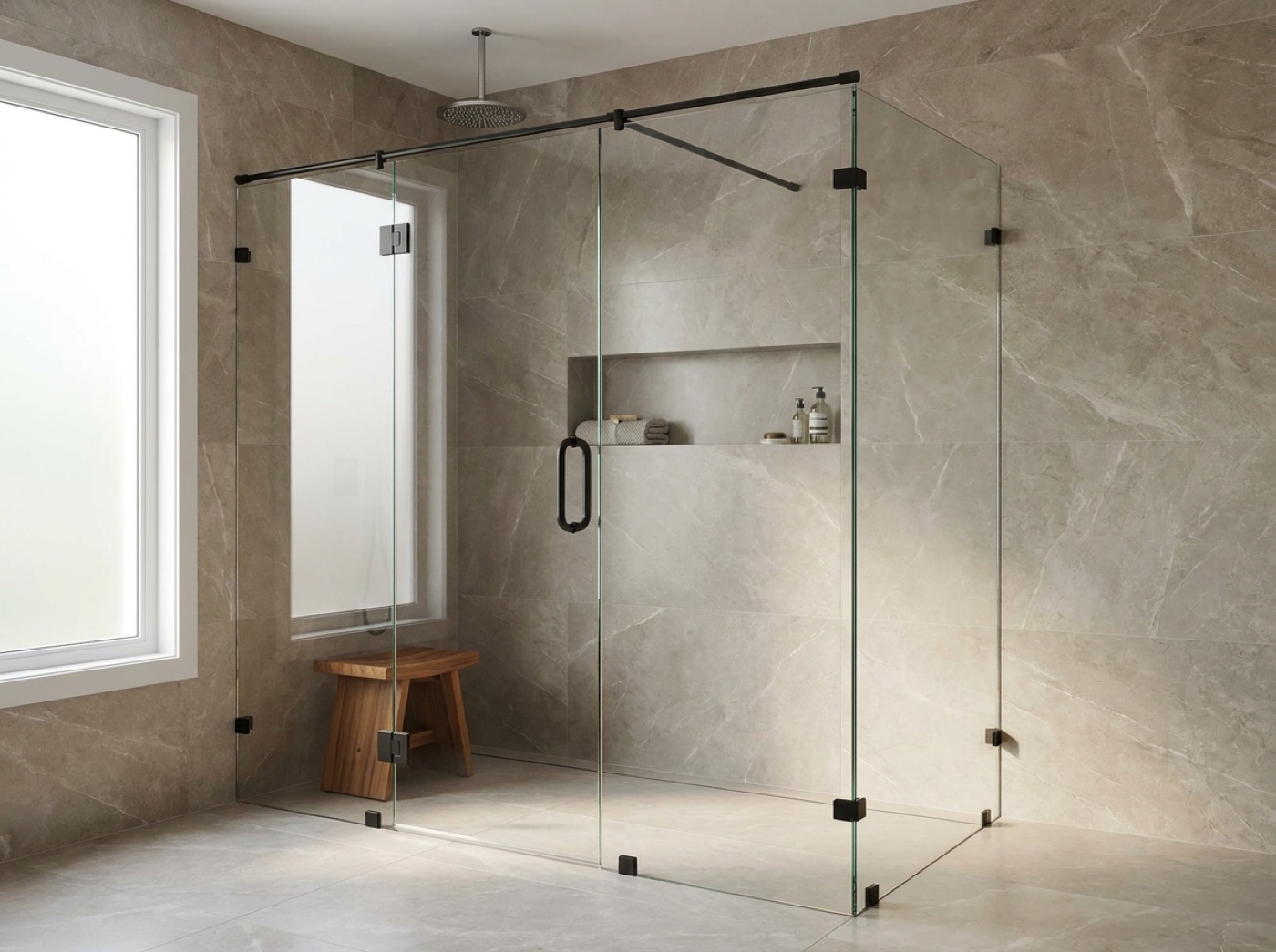
Framed vs frameless shower doors: which is best for your home?
The two enclosures look worlds apart, and the difference goes deeper than the metal. Here's how they actually compare on glass, cleaning, cost, and the kind of bathroom each one fits.
Same job, two very different builds
Walk into a showroom and the first choice you'll make is also the biggest one: framed or frameless. They both keep water in the shower, but almost everything else about how they're built, how they look, and how they're priced is different.
The short version is that a framed door wraps the glass in metal on every edge, while a frameless door uses thick tempered glass that holds its own shape with only minimal hardware. Neither is automatically 'better.' The right answer depends on your bathroom layout, your budget, and how much cleaning you're willing to do every week.
What a framed shower door really is
A framed enclosure surrounds the glass panel with aluminum on all four sides. That frame does the structural work, so the glass itself can be thinner, usually around 3/16". The frame also hides small imperfections, which is genuinely useful in older homes where walls and curbs are rarely perfectly plumb.
The trade-offs show up in two places. First, the look is busier; you see metal everywhere, and the frame visually shrinks the space. Second, those bottom and side channels are exactly where water, soap scum, and hard-water minerals like to settle. In metro Detroit, where hard water is a real, everyday issue, that buildup is the thing people complain about most over time.
- Lower up-front cost
- Thinner glass, hidden behind metal
- Forgiving of out-of-square or uneven walls
- More tracks and channels to clean
What makes frameless different
A frameless door skips the surround entirely. The glass is thick, typically 3/8" tempered glass, strong enough to stand on its own with only hinges, clips, or a header bar holding it in place. That's why a frameless enclosure looks so open: there's almost nothing between you and the tile and stone you paid for.
Because there's so little metal, there are far fewer places for grime to hide, which is the practical reason a lot of homeowners choose it. The catch is precision. With no frame to absorb error, every measurement has to be exact, and the glass is custom-cut to your specific opening. That's also why frameless costs more, and why who installs it matters as much as the glass itself.
- The most open, modern look
- Thick 3/8" tempered glass
- Far less metal, so less to clean
- Custom-cut to your exact opening
What actually drives the cost
The framed-versus-frameless decision is the single biggest price lever, because frameless uses thicker glass, heavier-duty hardware, and more precise fabrication. But a few other choices move the number too, and it helps to know them before you get a quote.
Size and configuration matter: a single swinging door over a tub costs less than a large walk-in with a fixed return panel. Glass choice adds up as well; clear is the baseline, while low-iron glass (which removes the faint green tint), satin frosted, rain-textured, and patterned glass each carry a premium. Hardware finish plays a smaller role, but matte black, brushed gold, polished chrome, and brushed nickel can each price differently. Because every bathroom is its own puzzle, we don't post flat prices; the honest answer is that it varies, and a free in-home measure is the only way to get a real number.
- Framed vs frameless (the biggest factor)
- Door size and walk-in vs over-tub layout
- Glass type: clear, low-iron, frosted, rain, patterned
- Hardware finish and number of panels
So which should you choose?
If you want a clean, open, high-end look and don't mind paying for it, frameless is hard to beat, and it tends to be the easier enclosure to live with day to day. If you're updating a guest bath, working to a tighter budget, or dealing with walls that are noticeably out of square, a quality framed or semi-frameless door can be the smarter, more practical call.
There's no wrong answer here, only the one that fits your room and how you'll use it. The best way to decide is to see the glass and finishes in person and have someone measure your actual space. Since the same family that helps you choose also fabricates and installs the door, what you pick in the showroom is what shows up on your wall.
Common questions.
Are frameless shower doors worth the extra cost?
For many homeowners, yes. You're paying for thicker 3/8" tempered glass, a more open and modern look, and far less metal to trap soap and hard-water buildup, which makes cleaning easier. If budget is tight or your walls are very uneven, a well-made framed door can still be the smarter choice. The best way to compare is a free in-home measure and quote.
Do frameless shower doors leak more than framed ones?
Not when they're measured and installed correctly. Frameless doors rely on precise fabrication, small gaps, and seals rather than a full metal channel, so installation quality matters most. A properly designed frameless enclosure manages water just as well as a framed one. This is exactly why having the same team measure, fabricate, and install matters.
Which is easier to clean, framed or frameless?
Frameless, in most cases. Framed doors have bottom and side channels where water, soap scum, and hard-water minerals collect, and those tracks are the part people find tedious to clean. Frameless doors have far less metal, so there are fewer places for buildup to hide, especially helpful with metro Detroit's hard water.
Not sure which door fits your bathroom?
Visit our Sterling Heights showroom to compare framed and frameless glass, finishes, and hardware side by side, or book a free in-home measure and quote. The same family measures, builds, and installs every door.