
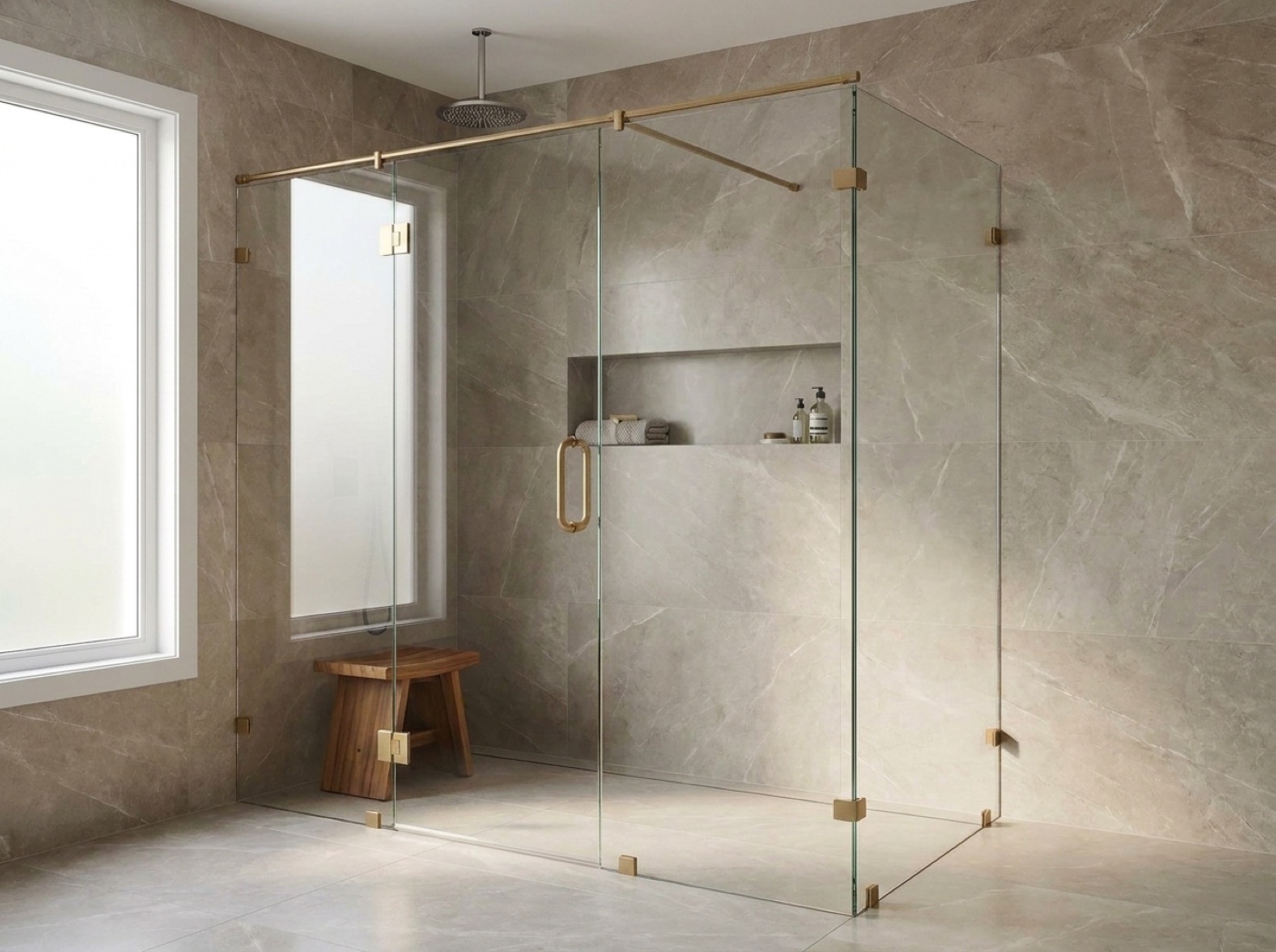
Glass shower enclosures in Michigan: style, function, and custom options
Corner, neo-angle, or inline? Here is how the three common enclosure shapes work, how custom sizing happens, and what gets planned before a single panel is cut.
An enclosure is more than a door
A single shower door swings or slides across one opening. An enclosure is the whole glass surround, two or more panels that wrap a shower and define its shape. That distinction matters in a lot of metro-Detroit bathrooms, where the shower sits in a corner, tucks under a slope, or replaces an old tub with a footprint that was never quite square to begin with.
Most enclosures we build in Macomb and Oakland County fall into three families: corner, neo-angle, and inline. The right one is usually decided by your existing plumbing and walls, not by preference alone. Here is how each behaves, and what we walk through before any glass is ordered.
Corner enclosures
A corner enclosure is exactly what it sounds like. Two glass panels meet at a corner of the bathroom, enclosing a shower that occupies that corner. You enter from the open side, through a swinging door, a sliding panel, or two doors that meet in the middle.
This layout is popular because it makes efficient use of a wall corner and keeps the open bathroom floor clear. With frameless or minimal-hardware glass, a corner enclosure reads as nearly invisible, which is part of why it pairs so well with the clean tile work we see in newer Sterling Heights and Troy builds.
The detail that earns its keep here is the corner joint itself. Where the two panels meet, the glass has to align cleanly and seal against splash. We plan that junction before fabrication so the panels arrive cut to match, not trimmed on site.
Neo-angle enclosures
A neo-angle takes a square corner and clips it with an angled front, creating a five-sided shower with a door on the diagonal. It is the classic answer to a small or oddly shaped bathroom, because it pushes the shower into the corner and reclaims floor space in front of it.
Neo-angles are common over older corner shower bases, and they reward careful measuring. Because the front door sits at an angle and the two side panels return to the walls, every angle and length has to be measured against the actual base and walls. A neo-angle that is even slightly off will not seal or swing correctly, which is exactly why we measure the real opening rather than working from a catalog size.
Inline enclosures
An inline enclosure runs straight along a single wall. The most familiar version is a fixed glass panel plus a door that together close off an alcove or a walk-in. Curbless and barn-style showers, increasingly popular in Oakland County remodels, are usually inline at heart, one long run of glass with a sliding or hinged opening.
Inline gives you the largest unbroken expanse of glass, which looks dramatic and shows water spotting more readily. That is one more reason hard water comes up in planning conversations here. We will often suggest a glass treatment, and we always cover squeegee habits, because a big inline panel is the surface where metro-Detroit mineral buildup shows first.
How a custom enclosure gets planned
Very few Michigan bathrooms have a perfectly square, standard-sized opening, especially in homes a few decades old where floors have settled and walls lean a fraction out of plumb. That is why nearly every enclosure we build is custom-sized rather than pulled off a shelf.
The same family that measures your space also fabricates and installs the glass, so nothing is lost in a handoff. A typical plan covers a handful of decisions:
Once those are settled, the glass is templated, fabricated to your exact numbers, and installed. Getting the planning right up front is what keeps the finished enclosure square, sealed, and smooth to use for years.
- The exact opening, measured against your real walls and base, not a nominal size
- Glass type and finish, from clear to low-iron, satin frosted, rain-textured, or patterned, all in 3/8-inch tempered
- Hardware finish and function, whether matte black, brushed gold, polished chrome, or brushed nickel, and whether the door hinges or slides
- How water stays in, the seals, sweeps, and panel overlaps that keep the bathroom floor dry
Common questions.
What is the difference between a shower door and a shower enclosure?
A shower door covers a single opening, while an enclosure is the full glass surround, two or more panels that define the shower's shape. Corner, neo-angle, and inline enclosures each wrap the shower differently depending on your walls and plumbing.
Are glass shower enclosures custom-sized?
Almost always. Few Michigan bathrooms, especially in older homes, have a perfectly square, standard opening, so we measure your actual walls and base and fabricate the glass to those exact numbers.
Which enclosure is best for a small bathroom?
A neo-angle is the usual answer for a tight or oddly shaped space because it tucks the shower into a corner and frees up floor area in front of it. The best choice still depends on your existing layout, which is what a free in-home measure sorts out.
Not sure which enclosure your bathroom wants?
Bring your layout to our Sterling Heights showroom, or book a free measure. The same family that plans your enclosure fabricates and installs it, all in-house.