
Steam and spa showers in Michigan: transoms, tight seals, and real-world venting
A steam enclosure is a different animal from a standard glass shower. Here is what actually changes when you want to trap heat and humidity on purpose, and still live with it day to day.
Why a steam shower is not just a hot shower
Most glass shower enclosures are designed to let a little air move. Tiny gaps under the door, an open transom over the top, a header that does not quite seal. That airflow is a feature on a normal shower because it lets the space breathe and dry out between uses.
A steam shower wants the opposite. You are deliberately filling the enclosure with hot vapor and trying to keep it inside long enough to actually enjoy it. That means the same gaps that help a standard shower become the things that bleed your steam into the bathroom, fog every mirror in the room, and load your drywall and trim with moisture they were never meant to hold.
So the real design question is not can we make the glass taller. It is: can we seal the box, give the steam somewhere to go on purpose, and still make a door a human being can open and a family can keep clean. In a metro-Detroit bathroom, with our humidity swings and our hard water, all three of those matter.
The transom: sealing the box to the ceiling
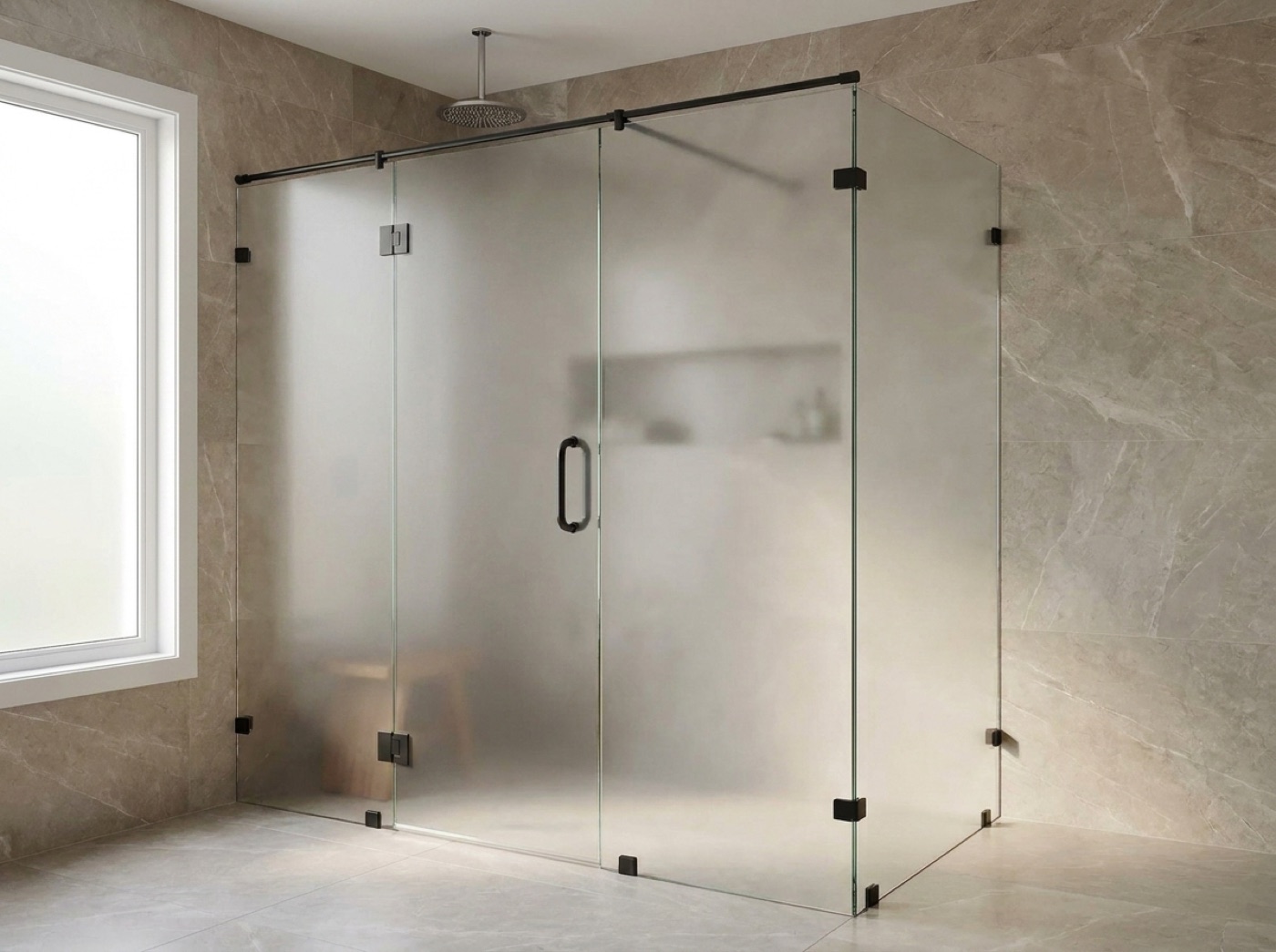
In a standard enclosure we often leave open space above the door so the room can breathe. In a steam build, that open space is exactly where your steam escapes, so we close it with a fixed glass transom panel that runs from the top of the door up to the ceiling.
That transom does two jobs. It seals the top of the enclosure so vapor stays in, and it keeps the whole wall of glass reading as one clean, frameless piece instead of glass-on-the-bottom and a painted gap up top. With 3/8" tempered glass top to bottom, a steam enclosure can look every bit as architectural as a regular frameless shower, just taller and tighter.
The trade-off is that a true ceiling-height steam box has to be measured and fabricated more carefully. Ceilings are rarely perfectly level, walls are rarely perfectly plumb, and a panel that runs all the way up has nowhere to hide a sloppy gap. This is squarely why we measure, fabricate, and install in-house rather than ordering a box and hoping it fits.
Tight seals everywhere the steam can find a way out
Steam is relentless. It finds the smallest gap and pushes through it. So a steam enclosure gets continuous seals where a normal door gets none, or only a token sweep.
In practice that means a full-perimeter approach: a sealed header across the top, side seals where the door meets the jamb, a bottom sweep that genuinely contacts the curb, and a tight seal where the transom meets the door and the walls. The goal is a box with one intended opening, the door, and one intended exit for vapor, the vent, and nothing else.
Hardware finish still gets to be a design choice here. Matte black, brushed gold, polished chrome, and brushed nickel are all on the table. But on a steam build the hinges, header, and seals are doing real mechanical work under heat and constant moisture, so it is worth choosing quality hardware and keeping it rinsed and dry.
- Sealed header so vapor does not escape over the top of the door
- Side seals at the hinge and strike edges
- A bottom sweep that fully contacts the curb, not just hovers near it
- Sealed joints where the transom meets the door and walls
Venting: the part people forget
Here is the counterintuitive truth. A steam shower has to be sealed while you are using it and able to dry out when you are not. A box that only seals, and never vents, becomes a humidity trap that grows problems behind the tile.
The usual answer is a small operable vent or transom at the top of the enclosure that you crack open after a session. Open it, let the box release its moisture into a properly exhausted bathroom, and the glass and tile dry instead of staying soaked. Some homeowners pair that with leaving the door ajar for a while after use.
None of that replaces a real exhaust fan. Your bathroom fan should be sized for the room and ideally run on a timer so it keeps pulling moisture for fifteen or twenty minutes after you are done. In Michigan, where bathrooms can sit cool and damp for months, that combination of a vent you open and a fan that runs on is what keeps a steam shower an asset instead of a maintenance headache.
What this means for living with it in metro Detroit
A steam enclosure is a premium build, and it earns that label because of the sealing and venting, not just the height of the glass. When it is done right, you get a genuine spa at home that contains its own steam and then clears itself out.
Day to day, the same habits that protect any frameless shower matter more here. Our hard water will leave mineral spots fast on glass that stays wet, so a quick squeegee after a steam session and a wipe of the seals goes a long way. Low-iron glass keeps that big wall of glass looking clear rather than green, which is worth considering when the whole front of your shower is one tall pane.
If you are weighing a steam or spa shower for a Macomb or Oakland County bathroom, the honest move is to talk through the room first, ceiling height, fan, framing, and how you actually shower, before anyone quotes glass. That is a free conversation, and it is the one that decides whether the finished enclosure feels like a spa or a sauna you cannot dry out.
Common questions.
Do I need a transom for a steam shower?
In almost every case, yes. A steam enclosure has to be sealed to the ceiling so vapor stays inside, and a fixed glass transom panel above the door is how we close that gap while keeping the look clean and frameless. A standard shower can leave that space open; a steam shower cannot.
Does a sealed steam shower still need a bathroom fan?
Absolutely. Sealing keeps steam in the enclosure while you use it, but the room itself still needs a properly sized exhaust fan, ideally on a timer, to clear the moisture that escapes when you open the door or vent. In Michigan's damp seasons, a fan that runs on for fifteen to twenty minutes after a session is what protects your trim and drywall.
Can a frameless glass shower be converted to a steam shower?
Sometimes, but it is rarely as simple as adding a transom. Steam requires continuous seals, a vent, the right exhaust fan, and often changes to framing and ceiling detailing. The right first step is a free in-home look so we can tell you honestly what your specific bathroom needs before quoting anything.
Let's talk through your bathroom before we talk glass
The same family measures, fabricates, and installs every enclosure in-house. Visit the Sterling Heights showroom or call (586) 315-8900 for a free, honest quote on a steam build sized for your room.