
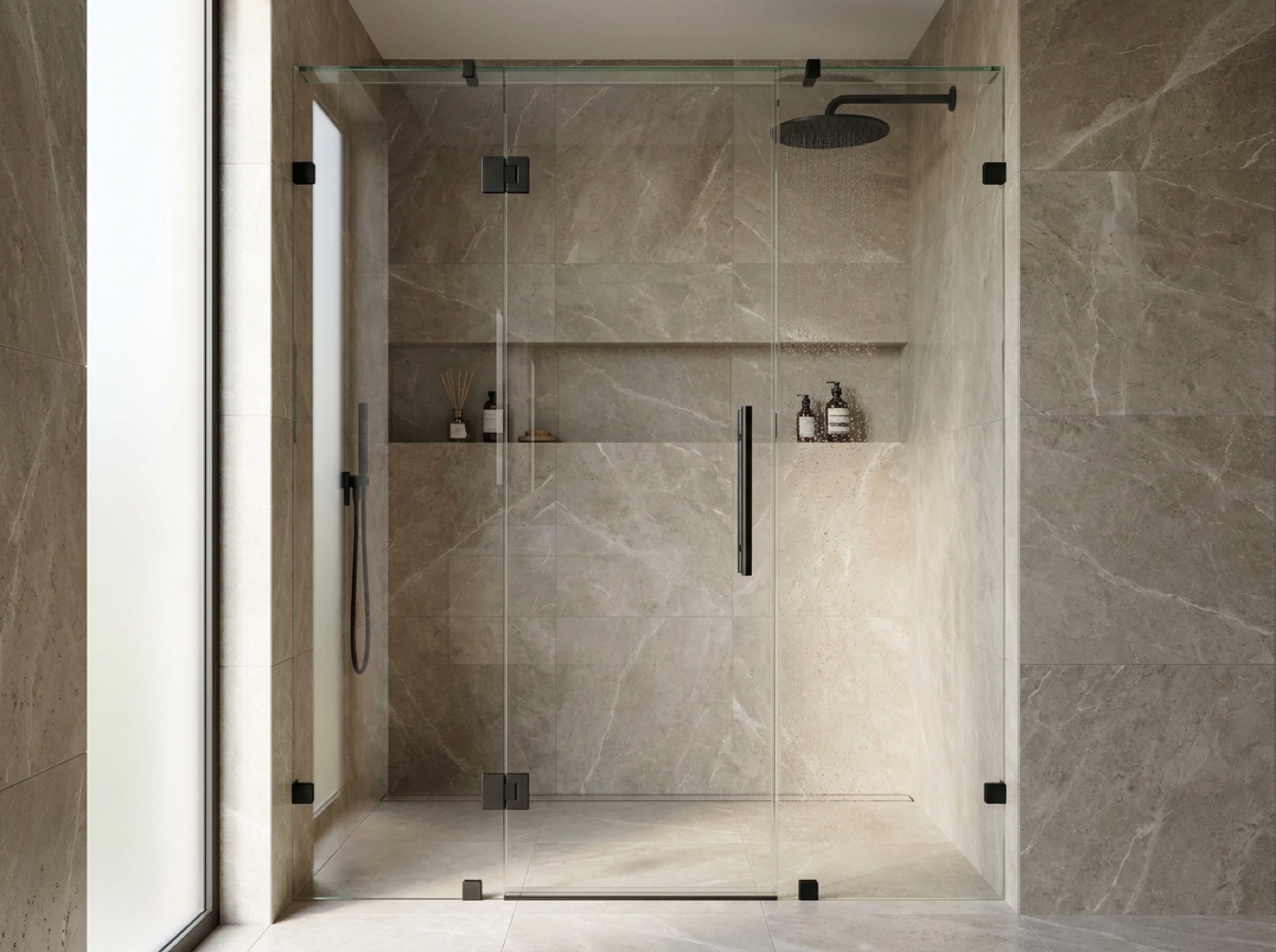
The best of both worlds: the case for semi-frameless shower doors
Frameless gets all the attention and framed gets the bargain shoppers. Semi-frameless quietly sits in the middle, and for a lot of metro-Detroit bathrooms it's the smartest pick on the board.
A middle ground that actually makes sense
Walk into most showrooms and you'll get pushed toward one of two extremes. Fully framed enclosures, wrapped in metal on every edge, are the budget standard. Fully frameless, with thick glass that seems to float, is the showpiece everyone photographs. Semi-frameless is the quiet third option, and it's one we end up recommending more often than people expect.
The idea is simple. A semi-frameless door uses a slim frame around the fixed panels and the perimeter, but leaves the door's swinging or sliding edge bare. You keep enough structure to support the glass and seal the wet zone, but you lose the heavy metal grid that makes a framed unit read as dated. From a few feet away, most people can't tell it from a frameless setup.
Where the cost savings come from
Price is usually the reason people land here, so it's worth being honest about why semi-frameless is cheaper. It's not a gimmick. It comes down to glass thickness and engineering.
Frameless doors typically run thick tempered glass, in the 3/8" to 1/2" range, because the glass itself has to carry all the structural load with no metal helping it. That glass is heavier, the hardware has to be beefier to hold it, and every exposed edge gets polished and precisely notched. Semi-frameless leans on its slim frame for support, so it can use thinner glass, lighter hardware, and fewer custom edge cuts.
We won't quote a number here because real pricing depends on your opening size, glass type, and finish. But as a general rule, a semi-frameless enclosure lands meaningfully below a comparable frameless one and above a basic framed unit. If you've got a number in mind, the fastest path is a free measure and quote so you're comparing real options, not internet averages.
- Thinner glass = lower material cost
- Standard hardware instead of heavy-duty frameless hinges
- Fewer polished, custom-notched edges to fabricate
- Lighter weight often means a quicker, simpler install
What you give up, and what you don't
No option is free of trade-offs. With semi-frameless you'll have a visible metal channel along the fixed panels and the perimeter. If your heart is set on the totally seamless, all-glass look, only true frameless delivers that. The slim frame is subtle, but it's there.
Here's what you don't give up: durability and a current look. The frame is so narrow on a well-made semi-frameless unit that it reads as a clean accent line rather than a cage. Pair it with a matte black or brushed gold channel and that thin frame actually becomes a design feature instead of something you're trying to hide.
One underrated perk in our area: that perimeter frame and channel help manage water. Around metro Detroit, hard water is a constant battle, and a framed wet edge gives water a defined path to drain rather than sheeting onto your floor. It's a small thing that matters when you're squeegeeing glass every week to fight mineral spotting.
Who semi-frameless is right for
We steer homeowners toward semi-frameless when they want the modern, open feel of frameless but the project budget has a ceiling, or when the bathroom is a secondary or guest bath where you'd rather put the splurge dollars into the primary suite. It's also a strong choice for rental units and resale-minded remodels, since it photographs clean and looks far newer than the framed enclosures buyers associate with older homes.
It's a great fit for both swing-hinged and sliding configurations. A semi-frameless swing door gives you that bare leading edge and a light, airy entry. A semi-frameless slider keeps your footprint tight in a smaller Sterling Heights or Macomb County bathroom without the bulk of a fully framed track.
If you're genuinely torn between the three, that's exactly the conversation our showroom is built for. We make the glass, hardware, and finish samples something you can see and touch side by side, so the decision stops being abstract.
Common questions.
Is a semi-frameless shower door cheaper than frameless?
Yes, typically by a meaningful margin. Semi-frameless uses thinner tempered glass supported by a slim frame, so it needs less material, lighter hardware, and fewer custom-polished edges than a fully frameless enclosure. Exact pricing depends on your opening size, glass, and finish, so it's worth getting a free quote to compare real options.
Does a semi-frameless door leak more than frameless?
Not inherently. The perimeter frame and channel on a semi-frameless unit actually give water a defined path to drain, which can help contain splashing. Any door can leak if it's poorly measured or installed, which is why an in-house measure matters more than the frame style itself.
Can I get a semi-frameless door in matte black or brushed gold?
Yes. The slim frame and channel come in finishes like matte black, brushed gold, polished chrome, and brushed nickel. On a semi-frameless door the thin frame reads as an intentional accent line, so a bold finish like black or gold often looks especially sharp.
See all three styles side by side in our Sterling Heights showroom
Frameless, semi-frameless, framed, with real glass, hardware, and finish samples in hand. We measure, fabricate, and install in-house, so the quote you get is the project you get. Stop by or call (586) 315-8900.