
Slip-proof your shower without making it ugly
Bathroom safety has come a long way from the chrome hospital bar. Here is how to build a shower that protects everyone in the house and still looks like a designer bath.
The bathroom is the most dangerous room in the house
Wet tile, a hard edge to climb over, glass, and a slick floor all live in one small space. It is no surprise the bathroom sends more people to the emergency room than almost any other room in the home, and most of those incidents happen getting in or out of a tub or shower.
Here is the part most people miss: you do not have to choose between a safe bathroom and a beautiful one. Done right, the safety features disappear into the design. A frameless enclosure, a grab bar that reads as a shelf, a curb you barely step over. None of it has to look clinical.
Start with the glass: tempered is the baseline
Every panel of shower glass we fabricate is 3/8" tempered safety glass. Tempering is a heat treatment that makes the glass several times stronger than ordinary annealed glass, and far more important, it changes how it fails. If a tempered panel is ever struck hard enough to break, it does not throw long razor shards. It bursts into thousands of small, rounded pebbles that are very unlikely to cause a serious cut.
This is not an upgrade you ask for. It is the floor we build on, and it is required by code for shower enclosures. The takeaway for safety: insist on tempered, and treat any glass enclosure that is not clearly labeled tempered as a red flag.
Grab bars that do not look like grab bars
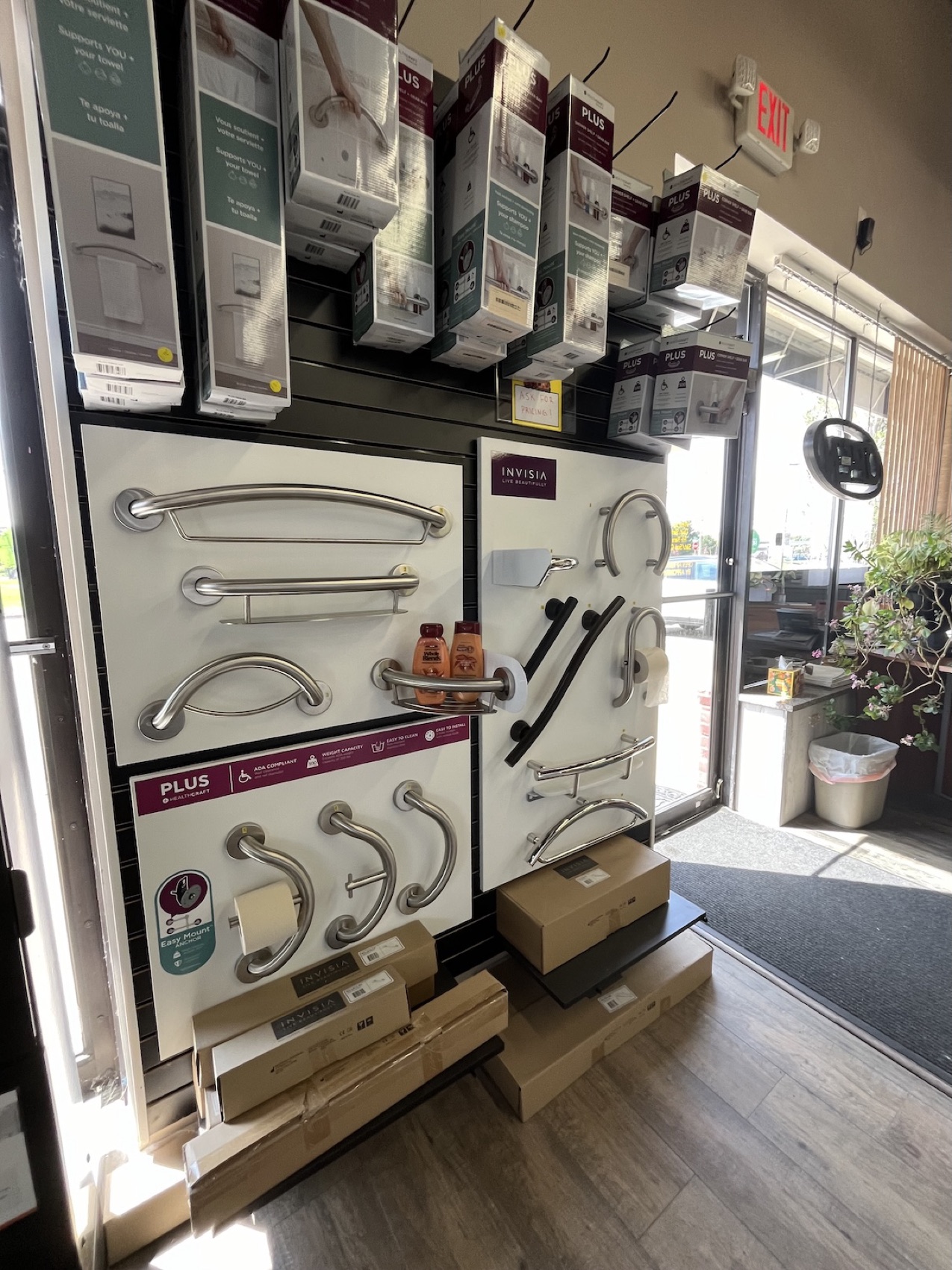
The old image of a grab bar is a stark chrome tube screwed to white tile. That era is over. Designer lines such as INVISIA build the grab bar into something you would want in the room anyway: a towel ring, a shelf, a corner caddy, a toilet-paper holder. Each one is rated to hold real weight, but it reads as decor.
The rules that make a grab bar actually safe are simple and worth knowing:
Mount it into solid blocking, not just tile and drywall. A bar is only as strong as what it is screwed to.
Place one bar near the entry for the step in and out, and one inside on the wall you naturally reach for.
Choose a finish that matches your hardware. We carry matte black, brushed gold, polished chrome, and brushed nickel so the bar disappears into the rest of the room.
The best time to plan this is before tile. Adding wood blocking inside the wall costs almost nothing during a remodel and is a real project to retrofit later.
- Mount into solid blocking, never tile alone
- One bar at the entry, one inside
- Match the finish to your other hardware
- Plan blocking before the tile goes up
Lower the curb, lower the risk
The single most dangerous moment in a shower is the step over the threshold. The higher that curb, the more you have to lift a foot over wet, slick edges. Lowering it, or removing it entirely with a curbless, zero-entry shower, takes that whole motion out of the equation.
A curbless shower needs a properly sloped floor and good waterproofing under the tile, so it is a job for the remodel stage, not an afterthought. But it pays off twice: it is dramatically safer, and a flush, frameless glass enclosure over a curbless base is one of the cleanest, most high-end looks you can put in a bathroom. If a full curbless build is not in the budget, even a low-profile curb is a meaningful improvement over a tall one.
Where slip resistance actually comes from
People often assume the glass keeps you from slipping. It does not. Slip resistance lives in the floor and the surfaces you grip, not the enclosure. Smaller floor tiles with more grout lines give your feet more traction than one big slab of polished stone. Matte and textured finishes beat high-gloss. A teak shower mat or bench adds a stable, non-slip place to stand and sit.
One safety note specific to metro Detroit: our hard water leaves mineral buildup on everything, and that film can make a smooth shower floor slicker over time. Keeping glass and tile clean with a squeegee and a regular wipe-down is not just about looks. It keeps the slip resistance you paid for from glazing over.
Design it so safety is invisible
Pull it all together and the result does not look like a safety bathroom at all. Tempered frameless glass, a low or zero curb, two well-placed grab bars that double as a towel bar and a shelf, a textured floor, and hardware finishes that all speak the same language. A guest would never read it as accessible. It just reads as a calm, well-built bath.
That is the goal we design for. Safety should be something the room does for you quietly, not something it announces. Whether you are building for aging parents, young kids, or just future-proofing a forever home, you can have all of it without a single concession to looks.
Common questions.
Are grab bars strong enough if they double as a towel bar or shelf?
Yes, when they are made for it. Designer accessibility lines like INVISIA are engineered and rated to support real weight while looking like ordinary decor. The key is mounting: the bar must be screwed into solid blocking inside the wall, not into tile and drywall alone. A decorative towel bar that was not built as a grab bar should never be used for support.
Do I need special non-slip glass for a safer shower?
No. Slip resistance comes from the floor and the surfaces you grip, not the glass enclosure. All our shower glass is 3/8" tempered, which is about safe failure if it ever breaks, not traction. For slip protection, focus on smaller textured floor tiles, matte finishes, a teak mat or bench, and a low or curbless entry.
Can I make an existing shower safer without a full remodel?
Often, yes. Adding properly mounted grab bars, a non-slip mat or teak bench, and a regular hard-water cleaning routine all help right away. Bigger changes like lowering the curb or going curbless involve the floor and waterproofing, so those are best done during a remodel. Come by the showroom and we will tell you honestly what is worth doing now versus later.
Plan a safer shower with us
Visit the Sterling Heights showroom to see tempered glass, INVISIA grab bars, and finish options in person. The same family measures, fabricates, and installs in-house. Free quotes.